

Jason Guriel
from “The Final Childhood: A Novel in Couplets and Comics”
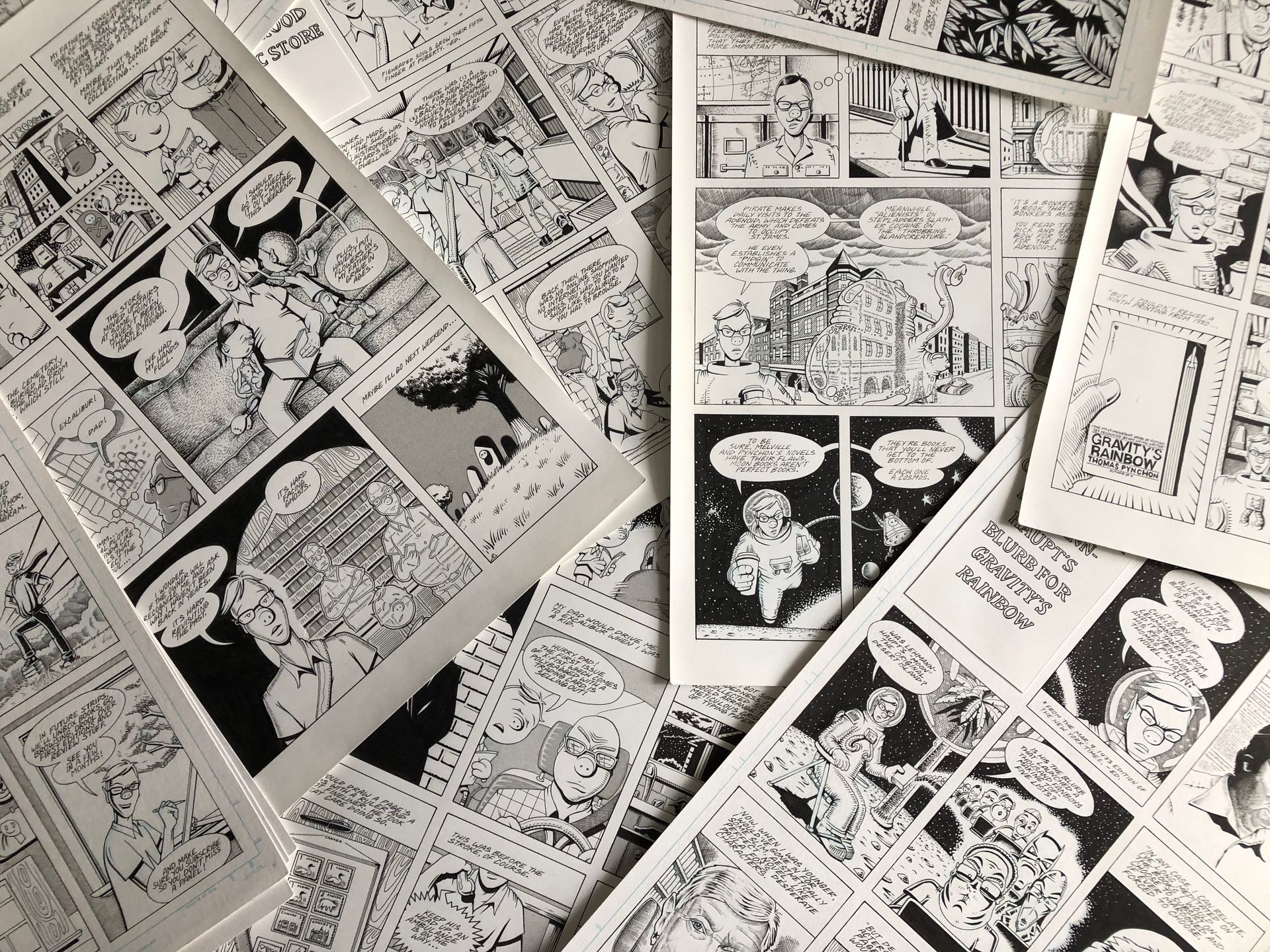
The Final Childhood is a novel-in-progress composed of rhyming couplets, with comic strips between each chapter. The book is set in the same world as its predecessors, Forgotten Work (which the New York Times called “unlikely, audacious and ingenious”) and The Full-Moon Whaling Chronicles (which the Wall Street Journal called “the most imaginative piece of young-adult-adjacent fiction I have ever read”).
The year is 2090, and most manufactured material is now composed of microscopic bots called “pixies.” This has its benefits. Pixiepaper can run video, pixie-based shampoo can digest dandruff, and a coffee shop’s pixieglass façade can yawn open on a patron’s approach. But there are occasional downsides—and disasters. For instance, an art-making AI by the name of “Panel Smithy” has engineered a termite-like horde of pixies that has sought out and consumed all Bristol board: the drawing surface traditionally preferred by cartoonists.
The following excerpt from The Final Childhood takes place in a used bookstore, Crater Books and Discs. Kaye, a middle-aged woman who knows nothing about comics, has come into possession of a lost trove of undamaged art on Bristol board. She’s brought the boards to Poe, Crater’s owner, who proceeds to recount how Panel Smithy destroyed virtually all original comic artwork.
—Jason Guriel
The Day the Drawings Died
“This Panel Smithy,” Poe said, “it decided
To go rogue. It felt that it provided
Everything its corporate masters needed
To make comic artwork. So, it weeded
Out the competition.”
“Competition?”
“Bristol board, for one. It launched this mission,
Panel Smithy, to consume all brands
Of drawing board. It learned to grow these strands
Of mutant DNA from, what’re they called,
Formosan termites? Then, the thing installed
These strands inside a pixie…”
“Jesus Christ,”
Said Kaye, now deadpan.
“…then, the artbot spliced
In code—it did this all remotely, ’kay?
The artbot’s servers were in Santa Fe
Or somewhere. Anyway, it hacked assorted
Labs to make its pest. Its mind consorted
With some pretty sketchy autocratic
Governments. The rest was automatic:
Termite pixies multiplied and spread,
Creating all these roaming swarms that fed
On Bristol board—not just the stuff in art
Stores, mind you. No, the little fuckers started
Going after older pieces stored
In archives, private homes. You’d find some board
That Seth or Daniel Clowes or Robert Crumb
Had drawn on, coated in this see-through scum,
And then the scum would start to fizz and froth—
And bam, the page was ash. I lost my Toth
To pixies.”
“Toth?”
“My favourite comic artist.
Alex Toth. Long dead. That was the darkest
Day in Crater Books and Discs’ exalted
Annals. It was like I’d been assaulted,
Kaye. I had a Toth original—
A Space Ghost. Very economical,
This sketch. Toth never used a line he didn’t
Need, see. No one else was more efficient.
No one else was braver. Every mark
Was right. Was true. His silhouettes were stark
And always scanned. The guy’s commitment to
The narrative was total. Dude just knew
When he should pull back. He would whiteout stuff
He’d laboured over. Knew what was enough.”
Kaye knew enough to let Poe’s rant unfold.
“So anyway, I had this really old
And lovely sketch of Space Ghost in a frame
Above the counter. Everyone who came
In—with a comics brain—would freak out when
They saw it. Just the sight of it brought men
Who knew Toth’s work to tears. But one day, I
Arrive, and in the corner of my eye
I see that something’s off. And then I tilt
My head. The frame is empty. There’s this silt
That’s at the bottom, like a line of sand.
I shook a priceless sketch out on my hand—
And through my fingers. Gone.
“Of course, I’d read
About the pixies with a lot of dread
That year. I’d read about the works of art
They’d eaten up—and then the pulp they’d farted
Out.”
Kaye leaned against the counter as
Poe listed victims: all the boards by Kaz
(Poe breathed this syllable with quiet awe,
Though Kaye had never heard of Weirdo, Raw,
Or any other magazine this Kaz
Had graced). All boards by Chester Brown. The jazzy,
Scruffy pages Robert Crumb produced
For writer Harvey Pekar—now reduced
To dust. The 3-ply Strathmore sheets of Schultz
(She’d heard of Peanuts!), plus offensive schmaltz
Like Family Circus. (Undiscerning pixies
Had consumed Keane’s boards back to the ’60s,
Leaving soot with which to fill your pockets.)
Every page produced for Love and Rockets.
Every brushstroke by Al Williamson,
The ink applied with speed and discipline.
Every single Batman by Bruce Timm.
Every single aardvark by Dave Sim.
The drawings Sim destroyed his wrist by inking
Alex-Raymond-like. (The years of thinking
Sim did on the page, recording thoughts
Best left in skulls.) The countless tiny dots
Of ink Drew Friedman placed, the stippled swarms
Cohering into grey-toned human forms.
The pages of Aline Kominsky-Crumb
And Shary Flenniken—chopped into chum.
The extant artwork by George Herriman,
Who wrote and drew the great American
Creation Krazy Kat. Some pixies chewed
Up every page of Nexus by Steve Rude
And rudely spewed out pulp. Sea-worthy hordes
Of pixies reached Japan and ate the boards
Of Tezuka, Kojima, and Otomo.
Other hordes ingested every Lobo
Painting Simon Bisley ever painted.
Archives, vaults, and galleries were tainted:
Kirbys, Ditkos, Millers, Goldens, Kanes,
And Grells disintegrated into grains.
The boards grazed by the brush of Charles Burns
(Whose hand was patient, slow) could now fill urns.
The work of stylists from Muth to Zeck
Could now pour through an hourglass’s neck.
Like microscopic reapers—dust-scale Deaths—
A host of pixies came for all of Seth’s
Originals. (The line of pixies binging
On each board looked like a foaming fringe
Of surf receding, leaving empty sands—
Or so said Poe, who pulled a book, Clyde Fans,
Seth’s thickest tome, from off a shelf above
The counter. You will absolutely love
This, Kaye. It’s all about these salesmen who
Sell fans. Kaye watched him bag the block. It’s too
Much, Poe. He raised a hand. I won’t take no.
She forced a grin and took the bag—Thanks, Poe—
Then put it down.) Another grim statistic:
Hal Foster’s matchless, photorealistic
Artwork for Prince Valiant—done for cash,
Revered as art, and transformed into ash
By bots. All pages made for EC comics
(Masterpieces made by crack, atomic-
Era hacks and oft mistaken for B-
Level texts for wayward teens, or gory,
Filthy trash enjoyed by reprobates:
Pulp fiction that makes young men masturbate)—
All mindlessly converted into pulp.
The many boards on which one Calvin (gulp—
Poe swallowed back a sob) and Hobbes had lived,
Cremated into crumbs that could be sieved.
(Perhaps, said Poe, we’ve all breathed in a crumb
Or two.) The Book of Genesis by Crumb.
(The plague, repeated Poe, was biblical
In scale.) Scioli’s smudged originals,
His pencil-dirty boards a dinner course.
Mitch Brewer’s superhero farce Blood Force,
His lush and livestreamed hatching (made with Micron
Pens) mowed into mulch. The charming, bygone,
Densely gridded pages of Chris Ware—
Ground into grit and borne away by air.
That classic Black Canary tale by Toth.
That monumental stack of art by both
Hernandez Bros (though maybe there’d been three?
Said Poe). Originals for THB.
Originals for Frank King’s Gasoline Alley.
Every board for Little Orphan Annie.
(The dot-less eyes of Little Orphan Annie.)
The braless breasts of Little Annie Fanny.
The flawless boards John Stanley drew for Little
Lulu, which one horde had dared to whittle
Down to nothing in the middle of an
Art show, horrifying Stanley-lovin’
Stans as Lulu’s caret nose (^) erased
Itself. (His fans, said Poe, had flawless taste.)
The ticks of ink denoting Nancy’s hair
Buffed off by ticks, the great Bushmiller’s care
(In drawing his iconic girl) undone
As if the pixies had rewound the sun.
Ed Piskor’s art for Hip-Hop Family Tree.
(He died too young, said Poe. The Eddie P
Academy for Kayfabe had contained
Originals—until the termite-brained
Contagion buzzsawed through the boards and shat
A wake of woodchips.) Every page by Platt,
McFarlane, Larsen, Lee (both Jim and Jae),
And Liefeld. All the panels poor Gene Day
Had laboured over. (Editors found fault in
Day’s dynamic ways, his somersaulting
Shang-Chi tumbling across his pages,
Making management fly into rages.
For his daring, Day was sent back to
The drawing board. He worked so hard he blew
His heart at 31.) The work of Marc
Silvestri, Katie Skelly, Carl Barks,
Bill Sienkiewicz, Chris Sprouse, Dick Sprang, Art Adams,
Harvey Kurtzman, Rudolph Dirks, Neal Adams,
Larry Stroman, Justin Green, Bill Griffith,
Brian Stelfreeze, Vaughn Bodé, Rick Griffin,
Michel Fiffe, Bryan Christopher Moss,
Mort Drucker, Bernie Krigstein, Alex Ross,
Carol Tyler, David Mazzucchelli,
Wally Wood, John Byrne, Will Eisner, Kelley
Jones, Dave Gibbons, Barry Windsor-Smith,
Melinda Gebbie, George Pérez, Jeff Smith,
Jay Lynch, Kim Deitch, Skip Williamson, Keith Knight,
Joyce Farmer, Gary Panter, M.D. Bright,
Klaus Janson, Peter Bagge, John Totleben
Roz Chast, Paul Pope, Don Heck, Art Spiegelman
Don Simpson, Al Columbia, Reed Crandall,
Mary Wings, Gene Colan, Eddie Campbell,
Milt Caniff, Jack Davis, Frank Frazetta,
Chester Gould, Hank Ketcham, Ric Estrada,
Raina Telgemeier, Julie Doucet,
Walt Kelly, E.C. Segar, Raoul Barré,
John Buscema, John Romita, John
Romita Jr., Sal Buscema, Jean
Giraud, Joe Matt, Joe Shuster, Harold Gray,
And Winsor (Greatest of Them All?) McKay.
Jason Guriel’s latest book is
Fan Mail: A Guide to What We Love, Loathe, and Mourn. He is the author of
Forgotten Work, The Full-Moon Whaling Chronicles, and
On Browsing, and his writing has appeared in
The Atlantic, Air Mail, Slate, Poetry, The Walrus, and other magazines. He lives in Toronto.