

Ned Balbo
Two Poets of the American Experience: New Collections by Rhina P. Espaillat and David M. Katz
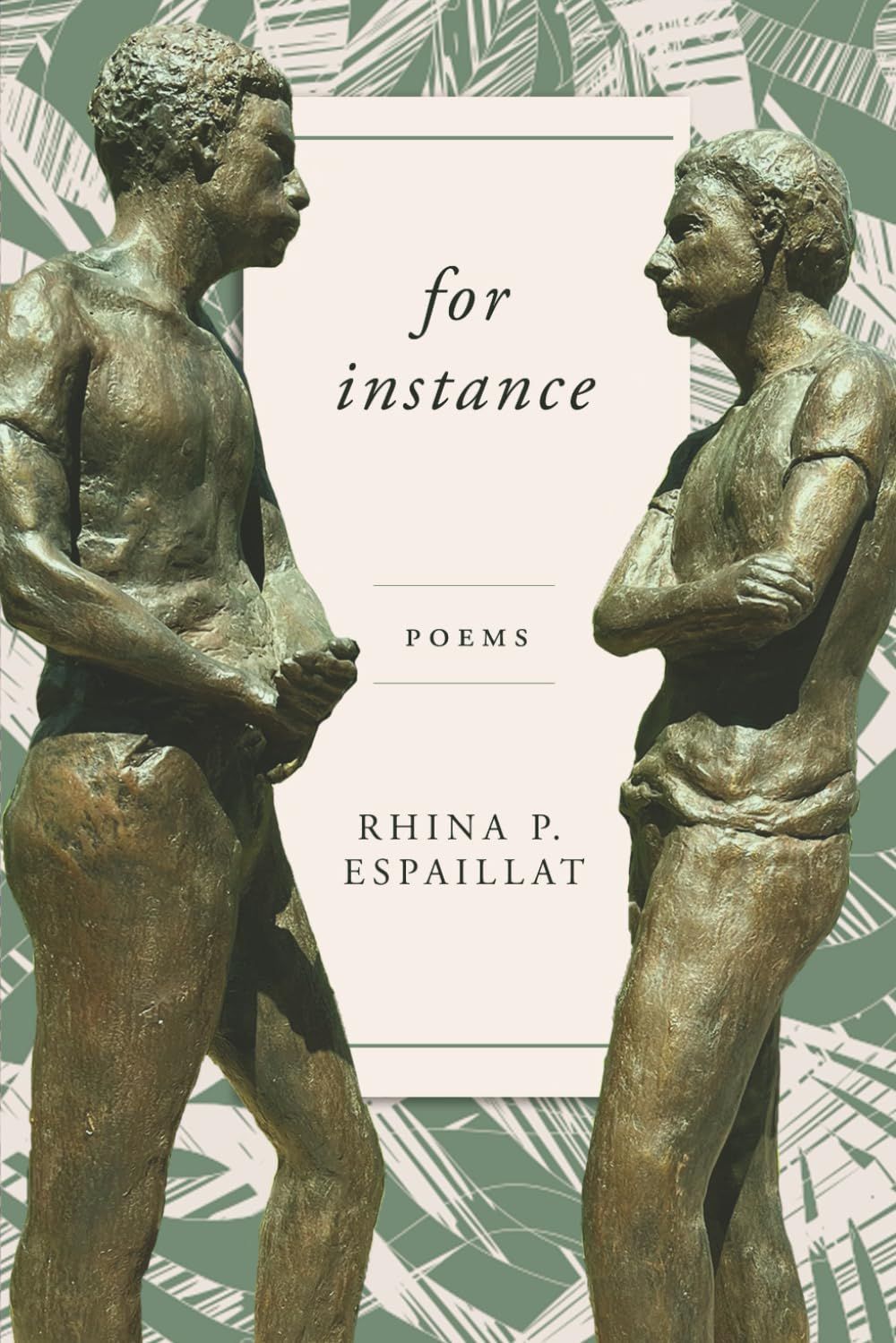
Rhina P. Espaillat, For Instance. Wiseblood, 2026.
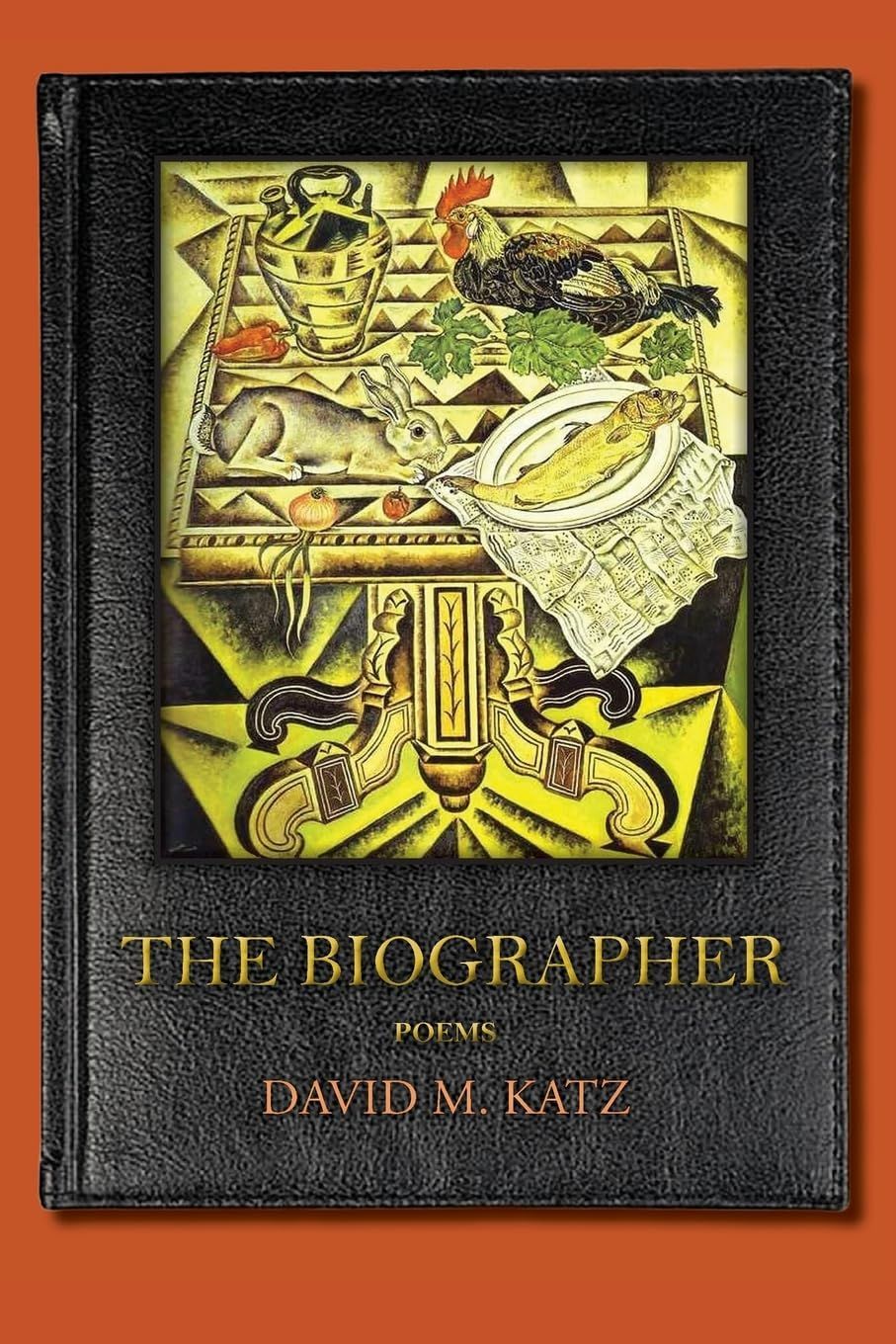
David M. Katz, The Biographer. Dos Madres, 2024.
In this semiquincentennial year, one national treasure we can all be grateful for is the Dominican-born American poet Rhina Espaillat. Both a prodigy (at fifteen, she published in Ladies’ Home Journal) and a late-bloomer (her muse went on hiatus while she taught and raised a family), Espaillat returned to poetry when she retired from the New York City public school system in 1990. Still writing at 94, she is less remarkable for her longevity than for the vision and craft that distinguish her body of work (at least fourteen books, including bilingual editions of her own work and Spanish translations of Richard Wilbur and Robert Frost). Espaillat’s new book, For Instance, is a persuasive testament to how acute insight and prosodic prowess can transform a life into extraordinary art.
“At the Next Table” is a case in point. A Shakespearean sonnet, the poem eavesdrops on the silent ASL dialogue of a deaf couple awaiting dinner: “How beautiful their fingers when they sign, / lit by the steady candle!” Espaillat observes their gestures closely: “They sing / with their four hands. Now he inscribes the air / with urgencies her palms, / tossed by the storm, / reply to.” Touched by the couple’s bond and made conscious of their own, the speaker and her partner leave the restaurant, “hands clasped” as they walk cautiously through sleet. The nonce sonnet “Bedside” takes a different tack. Its third-person speaker records a dying partner’s attempt at humor (“Silly joke—‘I love you more than you love me’—well meant / as a last, spicy, teasing argument”) but is haunted by the remark long after, “now echoing, ambiguous, obscure: / unanswerable charges from the dead.” In both poems, meter and rhyme guide a contemporary voice, literary yet accessible, its pacing and syntax neatly balanced. Espaillat would agree she makes good use of her influences. A faculty member at the Frost Farm conference held each year on the poet’s former property, she channels the master explicitly in “A Few Words from R.F.”, offering participants advice both poetic and practical (“Tell them no ghost could teach… / the one right way to reach / the solitude behind a stranger’s face… / Tell them to mind the side steps when they go.”)
Espaillat’s range of subjects reflects an alert intelligence. She responds deeply to nature, as shown by the haiku stanzas of “Twelve Meditations” whose lyric opening gives way to an experimental mode: “Clouds under marsh grass / Gray heron and his double / joined on the water” becomes, by the tenth meditation,
So much white lapping
So many tongues licking the
shore Barely water
(note the use of blank space). The lucent syllabic tercets of “Lesson” (which accompany Espaillat’s Spanish-language version) instruct the wind on how to “make a winter evening”: “Stitch carefully from / maple to maple a thin / humming wire / / clotted with sparrows; / spangle the earth with silver / tatters of rain.” Other poems recount po’ biz absurdities (“The Mail’s Here” ends, “I’m going to drown myself in a deep sonnet”), engage in ekphrasis (“‘The Education of the Virgin,’ by Georges de la Tour”), or consider Christian faith from a humanist, skeptical viewpoint: “‘So much to touch and taste!’ … / ‘to learn, to be,’” Eve exclaims excitedly on leaving Eden in “When Adam and Eve in the Grove Lay Sleeping,” a standout for its mix of wit and scriptural interrogation.
Espaillat confronts time’s passage, though in ways wholly her own. “Encounter” is funny and self-deprecating, its speaker addressing her aging mirror-image as if it is a real-life stranger—“Do I know you?”—only to conclude, tongue firmly in cheek: “What does an aging monkey want with one / as young and lovely as the rising sun?” (The couplet kindly allows the speaker to remain in denial.) “Going Under” begins playfully, its speaker telling her own body to “lie down meek / as a hostage” as sleep overtakes her, her voice growing more lyrical as apparitions surround her—the living, the dead, and generations not yet born:
I meet an army cheering me by name
gathered from every age, home to the dust
I am, their blood’s republic, meeting ground
of seed and sower and harvest held in trust.
Espaillat’s empathy for those fleeing tyranny or poverty lends poignance to works collected under the heading “Alien.” (Espaillat knows refugee status firsthand: on learning that Dominican dictator Rafael Trujillo had ordered a genocide of Haitians, Espaillat’s great-uncle, a diplomat, cut ties with his government, an act necessitating the family’s exile.) Though a few poems address the term more broadly—“Nightline,” for example, explores the enigma of boys who turn into school shooters, while “Pidgin” recalls the “living mix” of languages among 1940s New York immigrants— Espaillat’s main focus is on the “aliens” in our midst: aspirational Americans living under threat of arrest, deportation, or worse. “The Ballad of the Border Crossing” follows the ordeal of migrants whose deaths en route to the U.S. prompt indifference; in contrast, a bus rider who did reach American soil alive features in the book’s title poem, whose speaker witnesses the passenger’s forcible removal “cuffed in steel / for lack of an ID.” The speaker wonders what to do: “Urge him—in Spanish—to cooperate? / Or speak for him, and risk sharing his fate / by angering these guardians of the hive, / who may decide you look suspicious, too?” The poem ends with the speaker frozen, grasping for rationalizations that will justify inaction. Espaillat’s clearsighted compassion, ever mindful of human failings, is urgently needed—and not just in poems. Given this and other virtues, For Instance confirms Espaillat’s standing as an essential poet of the American experience.
*
David M. Katz, born on New York’s Lower East Side, is also attuned to the American experience. In The Biographer, a collection of marvelous shorter poems paired with the extended title sequence, twentieth-century history and family secrets collide in vividly realized scenes and painful conflict. Carefully sequenced, Katz’s book introduces his relatives through brief narratives or character studies. The father who raised him is a source of fascination: at age five, prevented from falling by “the firmness of his hand,” Katz recalls “[t]he New York City street surrounding us, / …the altitude / I’d have to climb before I knew the man” (“The Altitude”). It isn’t easy to know a father, and Katz faces several obstacles. His dad’s alcoholism is one: as he and his grown son converse long distance, Katz mentions he’ll soon be a parent himself, only to later express regret: “It’s now or never, Dad, I might have said. / Before my son was born my dad was dead” (“Are You Still Drinking, Dad?”). Another obstacle is his father’s business: the owner of a linoleum store left behind by changing trends, he laments selling “‘Only one can of Beacon Wax the whole day,’” and on arriving home, “brought the cold inside, or else the cold / Greeted him at the open door. . .” (“A Trickle of Warmth”).
Despite the above, The Biographer is far from gloomy. Katz treats his subjects with a rare generosity that mutes any potential bitterness without compromising emotional honesty. In “Ignis Fatuus,” a poem about his mother’s affairs, Katz’s deft touch with difficult matters proves crucial. Addressed to his sister, soon to undergo surgery on the West Coast, Katz, still in New York, uses the epistolary form to alert readers to their backstory. “Offstage, our mother had maternal flings,” we’re informed in rhymed quintains, resulting in the son and daughter raised with the alcoholic who was birth father to neither: “Our different fathers hover in the wings, / Hiding who was mine and who was yours.” Their mother’s vanity is clear: “…She stopped at any mirror / To fix her face, fashion us a life, / And rinse her hair in amorous water. / From coast to coast, electric star // Of the show…” Here, the poet’s love, awe, and sadness blend in ways familiar to any reader with a charismatic yet troubled parent; accordingly, the fleeting phosphorescence of the poem’s title is the ideal metaphor of loss and elusive understanding: “Vanishing, an ignis fatuus, / She left with us for Vegas on a red-eye— / With us, but already fading from us.” Larger than life when alive, the poet’s mother remains so in memory.
Tracing the family saga that is the book’s connective tissue risks neglecting many outstanding poems on other subjects that broaden its range: “A Prayer for Gerald Ford,” for example, identifies playfully with the athletic-yet-clumsy President who often became, unfairly, a punchline. With a rabbi’s view of man’s dual nature in mind, Katz declares that “clumsiness is next to godliness / And pray that Gerald Ford will be redeemed…” (Another favorite of mine is “Linseed Oil,” an ode to the substance used to soften baseball mitts, that, in its last turn, becomes a prayer.) Still, family is central here, though the verse novella that provides the book’s title upends expectations with its two fictional protagonists: the foundling brought to New York City on a cargo ship in 1914, “Nameless / infant in a pink blanket with the / Star / of David embroidered in blue”; and the biographer-narrator who, we learn, is her daughter, lost in research and speculations about her mother’s elusive past: “I / will try in the book to imagine her / now that I know / she died just a year ago,” further confiding, “My paucity of / contact / with her confers objectivity … / I suppose /…despite her diverse identities” (these, we learn, are adoptee Miriam Abramson, the novelist Mary Evans, and screen actress-activist Marion Allen—all the same person).
In this sequence, Katz, an admirer of Marianne Moore, trades his favored pentameter for a nonce syllabic stanza. The result is visually striking and sonically varied—a voice that moves easily from storytelling to pained disclosure to deeper questioning—but what answers are possible for a daughter whose mother moves restlessly between families and worlds, re-named and dedicated to reinvention? Escaping poverty, she gains fame in different guises, but these “diverse identities” only raise more questions. Her surprising career arc aside (there are such tales, however few), how did Miriam/Mary/Marion come to desert her daughter? And what about the biographer-narrator? Does she have a partner, a faculty job, a life beyond the quest of her project? In some ways, she’s more of a mystery than her subject, which only enriches the novella. Katz fashions a narrative with explicit parallels to his own biography but embodies enough differences, small and large, to point us toward its core: identity’s flux, history’s currents, the intricate dance of love and sorrow. As an inspired collection of poems, the book excels, but as a metafictional text that nudges our gaze toward its own making, The Biographer is both superb and fascinating.
Ned Balbo
is an award-winning poet and the author of six books, most recently
The Cylburn Touch-Me-Nots
(New Criterion Prize). Look for new poems just out in
Birmingham Poetry Review, Ecotone, Presence, Think Journal, and
V.I.A.: Voices in Italian Americana, as well as in
Attached to the Living World: a New Ecopoetry Anthology.